The Measurement Problem in the Age of ASI
What drives us insane about cancer and autoimmune disease is that we've thrown every cutting-edge sequencing technology at them and still can't explain why two patients with "the same" mutation can diverge completely. One responds. One doesn't. Same genomic profile. Different outcomes.
At some point, you have to admit the problem isn't more exomes. The problem is what we measure.
There's a quote from Dr. Richard Klausner that I keep coming back to:
"We cured cancer in mice decades ago, and it simply did not work in human beings."
This implies three things: good news, bad news, and great news.
The good: Biologists can cure what they can hold in context. Give a scientist a system they fully understand, and they will solve it. This is not a failure of intelligence or effort.
The bad: We can only seem to hold such context for homogeneous, simple, genetically engineered mouse models. We cannot reproduce decades of microenvironments, the heterogeneity, the accumulated chaos that human tumors actually experience. Mice are clean. Humans are not.
The great: AI can hold vastly more information in context than any human scientist. And cellular reprogramming now lets us model human organs in the lab with actual human cells, not just mice. Fuse these two together — AI and patient-derived biology — and you have the foundation for something that might actually work: a system that can hold human complexity in context and reason over it.
This implies moving past sequencing and finding entirely new low-hanging fruit.
The core belief that drives Precigenetics
What we can model, we can cure deterministically. What we cannot model is a luck of the draw.
Right now, biology is chained to the business models of CROs and instrument companies. We measure what can be shipped, installed, and serviced — not what would give us the sharpest possible view of cell behavior. Sequencing protocols and standard assays set the ceiling on what we're allowed to know.
Precigenetics is an attempt to move the ceiling.
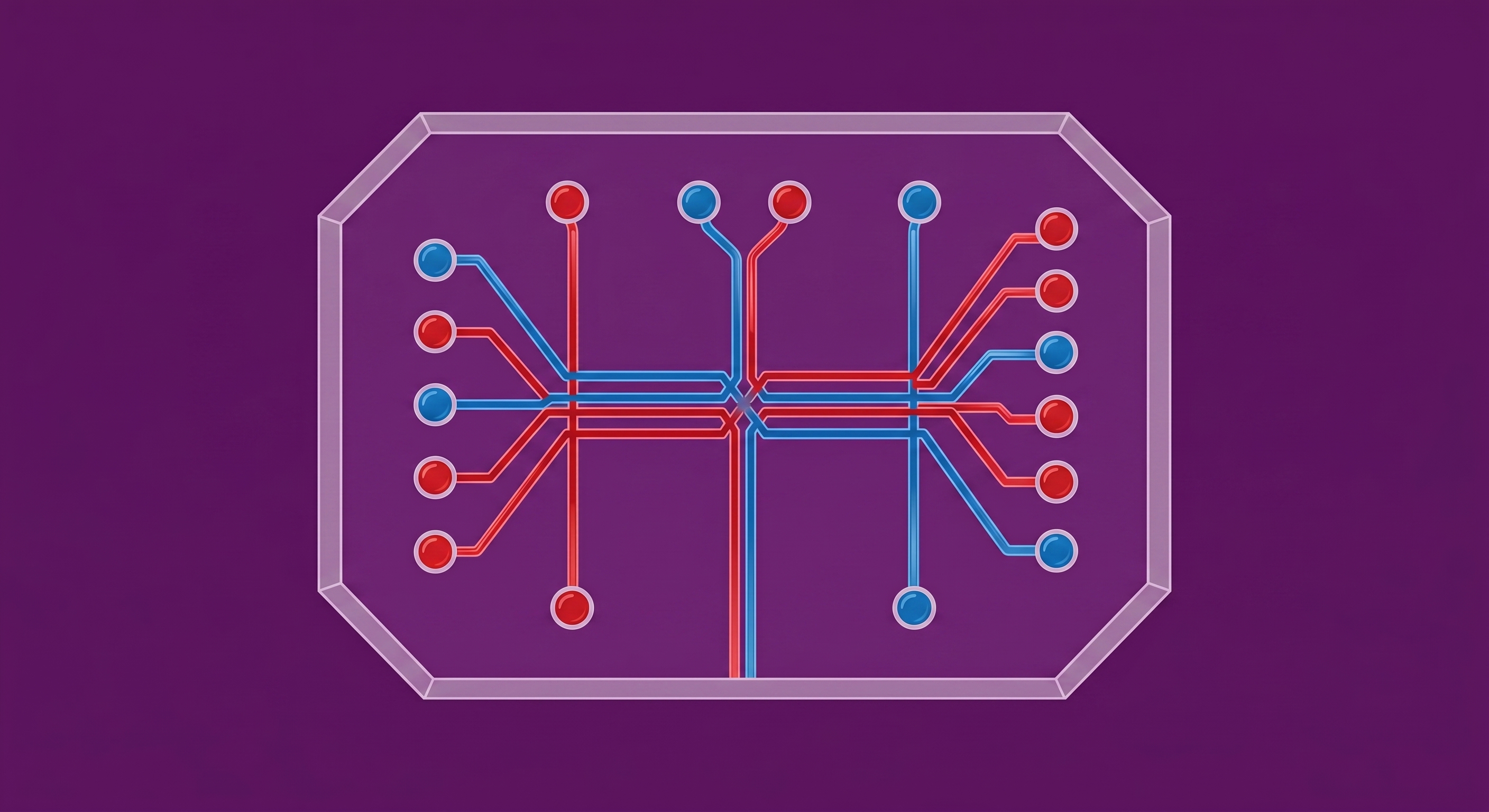
We build our own biosensing hardware. We run our own experiments on real patient-derived cells. We feed that data into models designed for continuous, time-resolved measurement — not another static snapshot. We are not in the business of selling equipment. We're not a research institute either. We exist to solve the pain point that keeps humanity away from more cures every single year.
We want Drug Discovery ASI. Deterministic drug discovery. Intelligence that solves the most painful and uniquely human problems.
Consider Parkinson's disease — a disease that has been failed, in part, by our model-of-choice being mice.
Mice do not naturally get dementia.
We've been trying to understand human neurodegeneration in animals that don't degenerate. And we wonder why the drugs keep failing in trials.
Human science needs to become accessible by letting AI be the generative interface to dimensions that human beings cannot even retain in their heads at the same time. Thousands of interacting variables. Temporal dynamics. Patient-specific contexts. No single scientist can hold all of that. But a model can — if you give it the right data.
That's the unlock. That's what we're building toward.
The FDA opens the door
With the new laws for FDA New Approach Methodologies, it is time to make drug discovery more deterministic.
"In the long-term (3-5 years), FDA will aim to make animal studies the exception rather than the norm for pre-clinical safety/toxicity testing. By this stage, validated NAMs could cover all critical areas, and FDA requirements can shift to a NAM-based default." — FDA Modernization Act 2.0
This allows for an AI-biosensing engine that tackles a first goal that is substantive: toxicity. That is the first proof of our platform, a groundbreaker for drug discovery. The most efficient AI drug discovery observes cells better, before falling back on guessing their behavior. This is our edge.
If we sold our instruments, we'd be stuck designing to the lowest common denominator — whatever other labs can operate, maintain, and understand. The system would freeze the moment it shipped.
Instead, we keep everything in-house and push it as far as physics, engineering, and biology allow. We don't optimize for what can be productized. We optimize for what gives us the clearest signal.
The only thing that matters is the mapping:
This patient's cells → These interventions actually work.
That's the job.
— Precigenetics